“I would highly recommend this book to would-be recovery coaches and experienced coaches alike, as well as addiction treatment and mental health professionals who will learn how to make use of a recovery coach as part of the clinical team.”
—Andrew Tatarsky, PhD., creator of Harm Reduction Theory and
Director, The Center for Optimal Living, NYC
• • •
“Melissa Killeen does what hasn’t been done before: a thorough explanation of recovery coaching. This will be an indispensable resource for both the coach just starting and the veteran. Well-researched, practical, and very readable.”
—Omar Manejwala, M.D.
Author of Craving: Why We Can´t Seem To Get Enough
• • •
The Third Edition Shines!
I run a behavioral health center that focuses on addictions and I’ve used the two earlier editions (2013 & 2020) of this book in my work because they are so comprehensive. This is the third edition of the book, and the updates freshen the content enormously. I consider this edition to be the most comprehensive resource for anyone serious about doing this work right (meaning, if you have editions 1 and/or 2, you now need 3)!
This edition builds on the solid foundation of the previous two but offers even more integration of contemporary treatment models. The Minnesota Model, Harm Reduction, and Recovery Management Model are all demonstrated as practical frameworks that counselors and case managers can actually understand and therefore use. The entrepreneurial guidance is solid too – how to set up your practice, find clients, handle supervision, all the business nuts and bolts that folks coming from lived experience might not have down yet.
What I appreciate most is that Killeen treats recovery coaching as the legitimate professional role it’s now become while honoring its roots in experiential knowledge. The book respects that you don’t need a clinical degree to do this work effectively, but you do need training, ethics, boundaries, and a goshdanged good toolbox.
If you’re pursuing certification, supervising recovery coaches, interning, or building your peer support programming, this is your go-to resource. It’s worth every penny.
– Dan Hostetler, Chicago Illinois
• • •
“I’ve worked in the addiction and recovery field for decades, and this 3rd edition is one of the most practical and ethically grounded recovery coaching resources available.
Much of the content in this book took me years of formal education, specialized training, supervision, and real-world experience to learn. Having it clearly and responsibly presented in one place is invaluable. I recommend this book every time someone asks me about recovery coaching or companion work.
This guide makes an important point that needs to be said plainly: recovery coaching is not something learned through personal recovery alone. While lived experience has value, it does not replace education, skill development, ethical training, or accountability—especially when working with vulnerable clients.
The book strongly reinforces that the goal of a recovery coach is client independence, not long-term dependency on the coach. Too many clients are kept reliant on coaches for years, whether intentionally or not. This book emphasizes empowerment, boundaries, and ethical practice. Coaches should never financially depend on a client’s long-term dependence.
If you are serious about doing this work responsibly—and not exploiting it—this book should be considered essential reading.”
— D. E. Detroit, MI
• • •
“Recovery Coaching: A Guide to Coaching People in Recovery from Addictions (Third Edition) is clear, concise, and full of extremely helpful information and a must-read for everyone from sponsors to therapists.
—Paul Liedtka
• • •
“I purchased your book, Recovery Coaching, through Amazon. . . I am the Regional Manager for Oxford House, Inc., and am now living in Corpus Christi, Texas. I am hopeful that I will be trained as a Recovery Coach trainer, working with residents of Oxford House to teach them how to become Recovery Coaches. This is why I purchased your book. I look forward to finishing the book and doing everything I can to help push the paradigm shift of recovery here in Texas toward the Recovery Management Model. Thank you for writing the book . . .”
—Jackson Longan, Corpus Christi, Texas
• • •
“I wanted to reach out to say thank you. I ordered your book, and it arrived today, and I am beyond thrilled. Recovery Coaching is something that I wanted to pursue when I was 8 months sober, and this past Jan 17th, I celebrated 5 years sober, and your book is a blessing. I have searched high and low for resources, programs, certifications, teaching, courses, etc., that would provide recovery coaching information and the how-to-do-it, and there are very few.
So I just wanted to say thank you. For writing your book and for opening the door for people like me. Thank you.”
With Gratitude,
—Alexis Chapman
• • •
“Melissa is very generous with her time and knows the Recovery Coaching field very well. I LOVE her new book. A must-read for anyone in recovery coaching.”
—Rosemary O’Connor
Author, Founder, ROC Coaching and Consulting Services
• • •
“Relapse rates are high. Studies indicate that eighty (80) percent of people relapse within the first year of discharge from addiction treatment. Nine (9) out of ten people relapse within the first 90 days. Peer support is critical to lasting recovery. Recovery coaching is one peer-related resource that can be used to bridge the gap between discharge from treatment and long-term abstinence from mood-altering drugs.
In her book, Recovery Coaching: A Guide to Coaching People in Recovery from Addictions (Third Edition), Melissa Killeen provides information about the occupation of the recovery coach. She describes the profession and provides information about the work of the recovery coach. She shares information about the recovery coach process and offers information about evidence-based models and techniques. She also provides entrepreneurial guidance for those who choose to earn a living in the field of recovery coaching.”
—Dr. Glenda Clare, Founder of Resilience Ready Counseling and Resilience Ready 360, Durham, NC
• • •
I have searched high and low for resources, programs, certification, teaching, courses, etc., that would provide information and the how-to, and there are very few that provide a methodology backed by solid research and real-life experiences. Thank you for writing the must-have book for anyone interested in Recovery Coaching. Thank you for opening the field up for people like me.”
—Alex
• • •
“This book provides useful information not easily found elsewhere. It provided lots of “insider” information. I would recommend it to anyone considering this line of work.”
—Debbie Garvin
• • •
“I’ve been a Recovery Coach in Ohio for the past five years, and in that time I’ve seen the establishment, the review and restructuring, and then redeployment of another RC program. I’ve been working full-time as a trainer/coach for three years and have tried to establish a solid baseline of understanding, practice, and support for a coaching program. Melissa Killeen has done an EXCELLENT job reviewing the history of coaching and established models of support, and then goes further by providing worksheets, assessments, and a working structure for the coach or support program to use in maintaining a quality, comprehensive paraprofessional support team. I’ve already recommended this book to numerous agencies with which I directly interface, and they have purchased copies for their libraries.”
—Chinagirl
• • •
Best Recovery Coaching resource I have found! This is a well-written, organized, insightful overview of recovery coaching from someone as skilled as she is, and who is very invested in this area.
I have read several books so far, and I have learned the most from this. I am in recovery, I am in recovery coach training, and I appreciate this book.
I. Rooster
• • •
If you are interested in purchasing Melissa Killeen’s new book, click below.
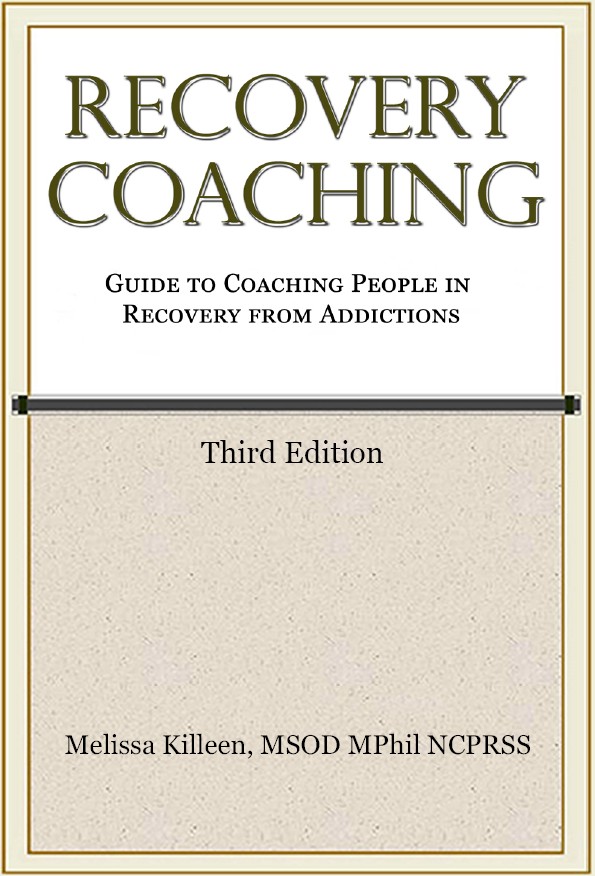
Recovery Coaching
A Guide to Coaching People in Recovery from Addictions
(Third Edition)